

Residence of the European Union: 'On the Move'
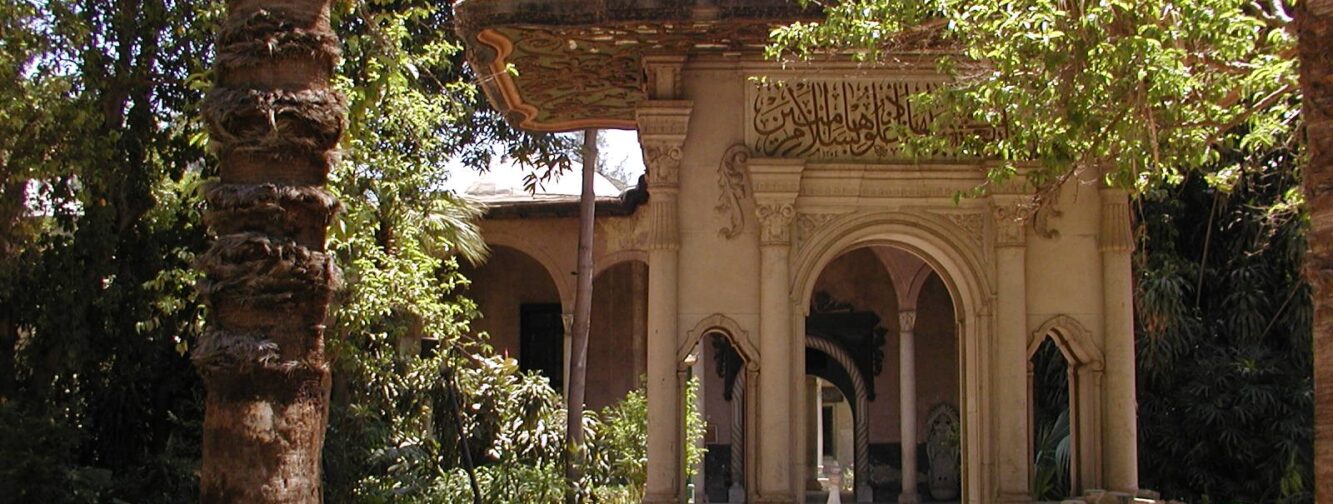
Once you are in, follow the natural disposition of the rooms and admire the sumptuous style of this early 20th century residence. After a few steps, you may find yourself in a significant contrast between the smooth lines of the furniture and the strength of the first paintings.
The entrance hall hosts four of Salah El Mur's works. One in particular caught our attention: two women are painted in different green, blue, and red tones on a green background; one of them is pregnant. Green should be the colour of hope but here it gives a sense of sickness. The women are almost blue in the face and their wide skirts remind us of a cage, as if they were somehow trapped.
This sense of anxiety becomes stronger once you are in front of Amre Heiba's controversial paintings in the room on your left. The title he chose for this selection of works, Still Life, is somewhat provocative. The artist represents living beings, humans and animals as if they were still in time and space as objects. His way of painting is very expressive, sometimes macabre, using such dark colours and pronounced outlines, with red shaded details that recall blood. Six other paintings of the same artist are exhibited in living room two.
The exhibition continues in the waiting room with four of Hany Rashed's paintings. You can't help noticing two of them for their big format, pop art inspiration and advertising style. On one of them, the square canvas is only painted with the three primary colours plus black and white. The square contains a circle in which two women from the 50's are gossiping. The other two paintings are more inspired by urban art and use collage techniques.
Along the corridor, Ibrahim s paintings are exhibited. Apart from one big sized work, the rest of his collection is made up of a series of small works on paper. El Haddad' asserts: "We see nothing truly until we understand it. And for me the real key for seeing, understanding, and making an art work is honesty". The walking men he paints are Probably going towards that quest for honesty the artist talks about.
The dining room is the last room and also the biggest one. It hosts eleven paintings: three from Xavier Puigmarti, three from Salah El Mur, and five from Georges Bahgory. We appreciated the title of Puigmarti's selection, which inspired by what happened in Egypt in the days after January 25th: Wireless.
The Salah El Mur paintings here are different from those of the entrance hall, showing something more tribal in their represented subjects and choice of colours.
Before having a deserved rest in the hidden garden, don't miss Bahgory's section which is on your right. You'll find a big painting probably representing a concert. We can recognize men playing instruments from an orchestra in the background, a couple dancing in the front, and an impressive Castafiore filling the space with her powerful facial expression.
All the 46 exhibited paintings are for sale.
There is a ‘sublime hysteria’ to everyday life, as the curators of 'Desire, Deceit & Difficult Deliveries' by Doa Aly say. Showing in Townhouse Gallery, the exhibition only seems to create a void in which this can easily be forgotten. In a contrived effort to illustrate the obsessive, yearning quality of daily life, through a crowded confused amalgamation of themes – ranging from Greek mythology to medical science – Aly fails in making her art what all good art should be: representational of its themes.
The collection comes across as a poorly reworked variation on an old theme, which has been done better elsewhere. The ideas are strong, however, the aesthetics, feeling, and heart required to convey such a principle concept are lacking. Overall, this exhibition is disconnected, hollow, and was ultimately a frustrating experience.
The first part of the show highlights four videos meant to tell something of the stories of the Ovid; it would take a great philosopher and historian to see this connection. But then again, maybe this is not necessary. The viewer is confronted with four videos, each in four parts, showing unidentifiable characters engaging in mechanical repetitious motions. It would seem as though the obsessive, repetitious movement of the characters on screen is meant to reflect our own schizophrenic nature, however, the rarefied atmosphere of the gallery and the removed characters, background and motions, make these pieces entirely un-relatable. In an attempt to create perhaps a universal atmosphere, Aly has created an irrelevant display that’s devoid of human feeling.
This absence of feeling continues on the first floor where an impressive text collage connects the poems of the Ovid with medical texts. Standing alone, this piece would have great strength, but as a bridge between two parts of the exhibition, we can see the artist attempting to create a narrative by force. That said, the first floor does feature some amazing drawings showcasing the artist’s talent as well as grasp of the themes presented.
The piece entitled ‘Roy’ offers a splendid conclusion to the exhibition. In this tragic piece we can see what this exhibition could have been. This piece shows a regular, relatable character and rather than underlying the fundamental themes of the exhibition and injecting it with human feeling, this very separate piece serves as a reminder of all that is missing in the rest of this show.
We found this show to be a somewhat removed handling of human feeling and lacking in terms of expressive and honest art, which could have better occupied this space.
Loading...